ADVERTISEMENT
 (No Ratings Yet)
 Loading...
Fullscreen
ADVERTISEMENT



 (No Ratings Yet)Loading...
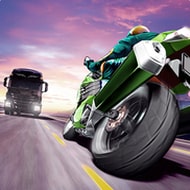
You’re sitting on a stock bike at the start line of the very first Career mission, engine idling, a stretch of highway traffic already crawling ahead in both directions. No boosts, no upgrades, nothing but a throttle and a lane full of cars moving slower than you’d like. That’s where every run of Traffic Rider actually begins, long before the near misses and the wheelie bonuses start piling up. The dashboard is stripped down to what matters: speed, a mission objective at the top of the screen, and traffic that isn’t going anywhere just because you’re in a hurry.
| Genre | Runner, Simulation |
| Platform-style | First-person motorcycle traffic-weaving |
| Core Mechanic | Lane-splitting, near-miss scoring, mission-based career |
Traffic Rider frames everything through the handlebars, which sounds like a small detail until you’re threading a gap between a bus and a pickup truck at speed and realize how little room for error a first-person view actually leaves you. There’s no third-person safety net showing you the road ahead in advance; you read traffic the way an actual rider would, reacting to brake lights and lane drifts as they appear rather than planning three cars ahead. That perspective alone is why so many first attempts end in a sudden crash that felt avoidable only in hindsight.
New players don’t get a choice at the start; Career mode is locked in as the only option until you’ve cleared enough of its missions, and that structure ends up teaching the entire game whether you wanted a tutorial or not. The campaign runs through somewhere north of ninety missions, each one built around a specific objective rather than just reaching a finish line: overtake a set number of vehicles, survive without a single crash, hit a target speed and hold it, or finish before a strict timer expires.
What keeps Career mode from feeling repetitive over that many missions is how the routes themselves shift. Day routes give you clear visibility and a false sense of security, while night routes cut that visibility down to headlights and taillights, forcing you to react to traffic you can barely see coming. Weather and road type change the mission pacing too, so a route that felt manageable in daylight can turn genuinely tense once the same stretch shows up after dark.
Every completed mission feeds back into progress in a very direct way: mission-clear cash goes straight toward the garage, and clearing enough Career missions is also what unlocks the other three modes. That’s part of why even players who eventually gravitate toward endless runs still talk about specific early Career missions, since those are the ones that taught them how to read a gap in traffic before committing to it.
The scoring system is where Traffic Rider stops being just about survival and starts rewarding aggression. Riding past 100 km/h and threading close overtakes past traffic cars triggers the near miss bonus, adding to both your score and your cash total for that run. It’s a risk-reward loop that never really goes away: the closer you cut it, the more you earn, and the more likely a single miscalculation ends the run on the spot.
A handful of scoring habits show up constantly once players get comfortable with the near miss system:
That last point is where a lot of runs actually end. Wheelies in particular are a divisive habit among regulars: some treat them as easy extra score on any open road, while others avoid them entirely because losing steering control for even a moment near dense traffic has cost them missions they were otherwise about to clear.
Cash earned from missions, overtakes, and near misses all funnels into the garage, where dozens of motorcycles wait to be unlocked across the course of a full playthrough. Each bike in Traffic Rider carries its own engine note, drawn from real recordings, so switching from an early scooter-class ride to a proper superbike changes the feel of a run before you’ve even left the start line. Speed, handling, and braking can all be upgraded separately, which means two players on the same bike can have noticeably different runs depending on where they chose to invest first.
Braking upgrades in particular tend to get underrated by newer players chasing raw top speed, right up until a night mission with poor visibility punishes a late reaction time. Handling upgrades matter just as much once traffic density picks up in the later Career missions, since a bike that turns sluggishly makes threading tight gaps for a near miss bonus far riskier than it needs to be.
Plenty of regulars settle on one favorite bike well before the garage is fully stocked, sticking with a mid-tier machine they’ve fully upgraded rather than chasing the flashiest superbike at the top of the list. Others treat unlocking every last motorcycle as its own long-term goal, grinding Career missions and near miss bonuses purely to keep the garage filling up.
Endless mode opens up early, letting you ride for as long as you can avoid a crash with no mission objective hanging over the run, which makes it the mode most players default to once Career missions start feeling like a grind. Time Trial unlocks a bit further into the campaign and strips things down to distance against a shrinking clock, where every near miss adds a small amount of extra time rather than cash, turning the same scoring system into a survival tool instead of a payout.
The last mode on the unlock chain sits apart from all three: no mission, no timer, no crash penalty pressure, just open road and traffic to weave through at whatever pace you want. Players who burned out on the precision demands of Career missions often land here, treating Traffic Rider as something closer to a relaxed cruise than the score-chasing game it is everywhere else.
Reaching that unlock chain takes real commitment, though, since the level requirements gating Endless, Time Trial, and the cruising mode all sit well past where a casual first session tends to end. That climb is exactly why so many players stick with Career mode longer than they originally planned; the modes waiting on the other side only feel earned once you’ve actually put in the missions.
Traffic Rider keeps pulling players back through that same loop, whether it’s chasing one more near miss bonus on a night route, finally affording the next bike in the garage, or just letting an unhurried cruise stretch out long after the last Career mission of the night is cleared.
There are no reviews yet. Be the first one to write one.