ADVERTISEMENT
 (No Ratings Yet)
 Loading...
Fullscreen
ADVERTISEMENT



 (No Ratings Yet)Loading...
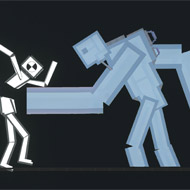
You open on an empty gray room with one ragdoll standing in the middle of it, arms loose, waiting for input that hasn’t come yet. You tap the spawn menu, scroll past guns and tools and machinery you don’t recognize yet, and drop a revolver at the ragdoll’s feet. Nothing happens until you make it happen. That blank-room silence is the starting point of every session of People Playground, and what you do with it next is entirely up to you.
| Genre | Simulation / Sandbox |
| Platform-style | Browser physics sandbox |
| Core Mechanic | Ragdoll physics with a large spawnable arsenal of weapons, tools, and props |
There’s no mission list here and no scoring system. Instead there’s a physics engine tracking weight, sharpness, heat, and pressure on every object you spawn, and a ragdoll body that reacts to all of it in real time rather than scripted animations.
Everything starts in that menu, larger than most players expect on a first visit. Ragdolls, vehicles, tools, weapons, and raw materials all live in the same list, organized loosely by category but genuinely deep once you start scrolling.
New players tend to spawn a handful of ragdolls first, just to have something in the scene. That instinct is correct. Nearly everything here is built around how objects interact with a body, so an empty room with no ragdoll doesn’t do much.
The menu doesn’t explain itself in depth, so a lot of early experimentation is clicking an unfamiliar icon to see what it does. That trial-and-error loop is part of the appeal, not a flaw players complain about.
The ragdoll model does more work than it looks like at first glance. Limbs have individual joints that can dislocate, skin that can tear, and internal states like blood pressure that respond to what’s been done to the body. A shot to a limb reacts differently than one to the torso.
This is where the game earns its reputation, fairly or not, as a gore sandbox. The injury modeling is detailed enough that players spend entire sessions testing what happens to a single ragdoll under different conditions rather than building anything at all.
It’s also the part that divides opinion the most. Some players find the physical detail excessive for what’s ultimately a toybox with no story attached. Others consider that same detail the entire draw, since it’s rare for a sandbox this open to simulate injury with this much specificity.
The weapon list alone would fill a session on its own. Revolvers, shotguns, grenades, a flamethrower, and an RPG sit alongside stranger entries like the freeze ray, which drops a target’s temperature until it stops moving rather than causing a conventional wound.
Tools blur into weapons here more than in most sandboxes. A chainsaw is as much a cutting tool as a way to dismantle a ragdoll, and props like a stray melon exist mostly so you have something harmless to test a new weapon on first.
Few players use everything in one sitting. Most gravitate toward two or three favorite tools and build sessions around those, which is part of why comparing notes about the arsenal is such a common conversation.
Firing a weapon here isn’t a canned animation followed by a death state. The engine tracks trajectory, penetration, and force, so the same gun can produce different outcomes depending on distance, angle, and what the ragdoll was doing when it got hit.
This is where the simulation side really shows. A grazing shot might just knock a ragdoll down. A direct hit at close range can be catastrophic. Nothing is scripted for effect; it’s closer to a genuine physics result than a horror-game jumpscare.
Newcomers often describe their first few minutes as more clinical than expected, watching how a body actually responds rather than just triggering a gore effect. That realism keeps longtime players coming back to test specific scenarios.
Death here isn’t always permanent. A defibrillator can restart a ragdoll’s heart, and other medical tools sit in the menu for treating wounds rather than causing them.
The catch is that revival only works within limits. A ragdoll with catastrophic damage, like a fatal shot to the head, won’t respond no matter how many times you try. That boundary keeps the medical tools from feeling like a cheat code.
Players interested in the survival side often build scenarios around it: injure a ragdoll deliberately, then race to stabilize it, flipping the usual destructive instinct into something closer to triage.
Beyond ragdolls and weapons, People Playground includes machinery you can wire together, from simple pistons to elaborate contraptions that trigger a chain of events after one click.
Building one of these setups usually follows a rough pattern players fall into naturally:
These builds rarely work on the first attempt, which is part of the appeal for players who treat this less like a gore sandbox and more like a physics puzzle they’re designing themselves.
There’s no ending, no unlockable content, and no failure state sending you back to a menu. A session ends when you decide it does, which is either liberating or directionless depending on what you walked in wanting.
That openness is the single most common point of friction for new players. Without an objective, the first few sessions can feel aimless until a specific idea, a chain reaction, a rescue scenario, a weapon test, gives the sandbox a shape it doesn’t provide on its own.
Longtime players tend to treat that open-ended format as the entire point. There’s no other mode to switch to and no scoreboard to compare against, just a room, a ragdoll, and whatever idea you brought in with you today.
A large share of what makes long-term sessions interesting comes from creations other players have built and shared, expanding the spawn menu well past its original contents. New ragdoll types, weapons, and entire contraptions circulate constantly.
Browsing these additions has become its own activity separate from actually playing. A lot of players spend as much time testing what someone else built as they do designing their own scenarios from scratch.
That constant inflow of new content is part of why sessions from a year ago and sessions today can look completely different even though the core sandbox hasn’t changed underneath it.
Whether the last thing you built in People Playground was a chain reaction involving a piston and a spinning blade, or just a single ragdoll testing the freeze ray for the first time, the sandbox never stops being exactly as chaotic or as careful as you decide to make it.
There are no reviews yet. Be the first one to write one.