ADVERTISEMENT

 (2 votes, average: 3.00 out of 5)
 Loading...
Fullscreen
ADVERTISEMENT







 (2 votes, average: 3.00 out of 5)Loading...
 You slide a fresh cup of chai across the counter, a passenger nods and turns toward the platform, and for a second the station lights dim just slightly longer than a normal flicker should last. Nothing about the moment is explained. That’s the pace Railway Chai Wala runs on, and it’s why the opening hour feels ordinary right up until it doesn’t.
| Genre | Psychological thriller, simulation |
| Setting | Fakripur railway station |
| Playable character | Ramu, the station chaiwala |
| Perspective | First-person |
| Player count | Single-player |
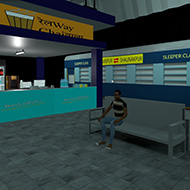
The core loop in Railway Chai Wala is deceptively small. Ramu stands behind a stall at Fakripur station, and every train that pulls in brings a fresh wave of passengers who want chai, coffee, samosas, vada pav, or a bottle of Kokila Kola before their platform empties again. Managing that rush is a genuine skill test early on, since the game gives no real tutorial cushion once the second or third train arrives back to back.
Newer players tend to treat the stall like a checklist instead of watching what’s happening around it, and that’s the first mistake the game quietly punishes. You can serve every order correctly and still miss the parts of the station that matter. A passenger who lingers near the tea counter after their train has already left isn’t a bug in the schedule — it’s the game telling you to pay attention.
What keeps the cooking loop from feeling repetitive is how ordinary it stays. There’s no combat, no inventory grind, just chai, coffee, and snacks, and the tension comes entirely from what’s layered underneath that routine. Players who go in expecting jump scares every few minutes tend to come away disappointed, while players who let the quiet stretch of pouring tea sit uncomfortably long usually end up more unsettled by the time the story shifts.
Ramu isn’t given much backstory upfront, and that’s intentional — you learn who he is through how he reacts to the station rather than through exposition dumps. Early mistakes usually come from rushing dialogue. Skipping through passenger conversations to get back to serving drinks is the single most common misstep, because those short exchanges are where Fakripur station starts dropping details about what’s actually going on beneath the platform.
None of these mistakes fail the game outright. What they do is flatten the experience into a cooking sim with no weight to it, which misses the point entirely.
The menu itself is small and grounded — chai, coffee, samosas, vada pav, and bottles of Kokila Kola — and that ordinariness is doing more work than it looks like. Horror communities online have compared Railway Chai Wala to the Fears to Fathom series for exactly this reason: nothing about the setting is exaggerated, which makes the moments where it breaks its own rules land harder. A regular who orders the same thing at the same platform every visit becomes noticeably strange the third or fourth time it happens, not because anything visibly changes, but because you start counting.
Speedrun-minded players and story-focused players tend to experience Fakripur station very differently. One group is optimizing serving time and barely registers the passenger dialogue; the other is replaying conversations to catch lines they think they missed. Both approaches work, but only one of them actually surfaces what the station is hiding.
By the time you’ve served a handful of trains, the station stops feeling like background scenery. Sound design carries a lot of this shift — the announcement chimes and distant train horns are consistent early on, then start arriving at moments that don’t quite line up with a train actually being there. It’s a small detail, but it’s the kind of thing players bring up constantly in discussion threads because it’s easy to miss and hard to un-notice once you catch it.
One thing the community is split on is pacing. Some players find the slow build essential to how the dread lands later; others feel the middle stretch leans too heavily on repeated counter work before the story earns it. Both reactions are fair, and it’s worth knowing that going in rather than expecting constant escalation.
It plays as a simulation game for stretches at a time, with real cooking and serving mechanics, but the horror elements are structural rather than jump-scare driven. The unease builds through repetition and small inconsistencies at Fakripur station rather than sudden shocks.
Ramu’s stall covers chai, coffee, samosas, vada pav, and Kokila Kola. The menu stays small on purpose, which keeps the counter work readable even as the surrounding story gets stranger.
Stylistically, yes — both lean on grounded, everyday settings rather than supernatural spectacle, and both trust silence and small detail over constant scares. Players familiar with that series tend to settle into Railway Chai Wala’s pacing quickly.
Railway Chai Wala works because it never lets Fakripur station feel like a set piece — it feels like a shift you’re actually working, right down to Ramu wiping down the counter between trains while something about the platform quietly stops adding up.
There are no reviews yet. Be the first one to write one.