ADVERTISEMENT
 (No Ratings Yet)
 Loading...
Fullscreen
ADVERTISEMENT




 (No Ratings Yet)Loading...
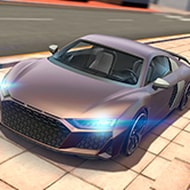
Extreme Car Driving Simulator markets itself on the word simulator, but the first time you clip a curb and watch the front end crumple, it becomes clear this is closer to a demolition sandbox than a driving school. The physics punish sloppy steering, yet the whole game is built around spending that realism on drifting and testing how much a chassis can take before it stops looking like a car.
| Genre | Driving simulation, open-roam action |
| Platform | Browser, PC and mobile controls |
| Core Mechanic | Physics-based driving with drift, damage, and multiple vehicle modes |
Open World mode is where most players spend the bulk of their time: a city map with roads and intersections, none gated behind a mission. Green circles offer optional delivery jobs, but ignoring them and just driving is a valid way to spend a session.
Sidewalks stay off limits during jobs, minor until you are weaving through traffic and realize the curb is the only thing between you and a clean escape.
Traffic is not scripted to chase you, but it is dense enough that plotting a line through it becomes its own puzzle at speed. Clipping a car at the wrong angle can end a drift chain instantly, a quiet skill the map teaches.
The damage system is not cosmetic scratches, it is a deformation model that dents and disables parts the longer you drive recklessly. A fender folding after a head-on hit looks satisfying for about five seconds, then the steering pulls and the engine smokes.
This is genuinely divisive. Some veterans find the escalating wreckage thrilling, chasing crashes to see how mangled a car gets before it stalls, treating a mangled chassis as a challenge run rather than a failure. Others find it frustrating in Race Mode, where one bad clip against a barrier ruins an otherwise clean line.
Refresh is the escape hatch, resetting a wrecked vehicle onto the road without restarting. Newer players lean on it constantly while learning where traffic gaps actually are.
Drifting is less about holding a button and more about throttle against steering, rewarding a slide that keeps the rear end loose without spinning out. Stringing a burnout into a drift is a small combo the community treats as a genuine flex.
Parking Mode strips the chaos away for the opposite skill: precision. Ten cramped green zones force slow, careful inputs right after a throttle-heavy Open World session, and that whiplash makes switching modes worthwhile.
Stunt Mode leans into spectacle, sending a car across ramps toward a finish line across ten stages. Landing a jump clean without the front end folding takes the same damage-awareness Open World teaches.
Race Mode drops the open-roam pacing for ten checkpoint levels against a single AI opponent, testing the driving model hardest. Cornering fast without clipping a wall means respecting the physics that make Open World fun, which surprises players who treated the earlier hours as chaos.
Camera choice matters more here, since the angles change how easy it is to judge an apex at speed. Competitive players settle on whichever view gives the clearest read on the front end.
What ties every mode together is that none exist in isolation. A drift habit built in Open World carries into Race Mode corners, and respect for the damage model keeps a Stunt Mode landing from ending in a wreck.
Not really. Open World hands out optional delivery tasks through green circles, but there is no required campaign, so a session can pass without a scripted objective.
Yes, sustained collisions crumple the body until the car is undriveable, at which point Refresh is the only way back onto the road.
Since every car carries different Control, Power, and Max Speed values, the strongest pick favors Control and Power over top speed, since checkpoint levels reward cornering over straight lines.
Extreme Car Driving Simulator earns its name once you have wrecked a car in traffic, parked one in a space barely wider than its body, and landed a Stunt Mode jump with the fender hanging by a thread.
There are no reviews yet. Be the first one to write one.