ADVERTISEMENT
 (No Ratings Yet)
 Loading...
Fullscreen
ADVERTISEMENT




 (No Ratings Yet)Loading...
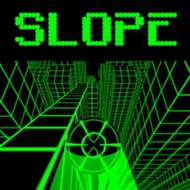
The ball in Slope never actually stops accelerating — there’s no cap built into the track, no speed ceiling waiting to save you, just a tilting descent and a run that keeps getting harder to read until it isn’t readable at all.
| Genre | Endless 3D runner |
| Core Mechanic | Steer a rolling ball down a procedurally-tilting slope |
| Controls | Left/right arrow keys or A/D |
| Goal | Survive as long as possible, beat your distance score |
Slope doesn’t hand you a fixed course. The track tilts, narrows, and drops away in front of the ball in real time, so no two runs play out the same way twice. You’re not memorizing a layout the way you would in a level-based platformer — you’re reacting to whatever the descent throws down half a second before the ball reaches it.
The red blocks are the one hazard that ends a run outright on contact, and players learn fast to treat that color as an instant no. Most other colored obstacles can actually be barreled through — knocked aside by the ball’s own momentum — which trips up a lot of first-time players who assume every solid shape on the track is off-limits.
Tunnels complicate that read further. Passing through one gives the ball a hard burst of speed, which sounds like a reward until the next set of gaps arrives faster than your reflexes had adjusted for. Good runs in Slope are less about raw reaction time and more about accepting that the track is actively trying to outpace your judgment.
The single hardest skill in Slope isn’t steering — it’s reading the edge of a gap early enough to commit to a direction before the ball is already over it. New players tend to steer reactively, waiting until the drop is visible right in front of the ball, which at higher speeds is already too late.
Veteran players describe this as playing a beat ahead of the ball rather than on top of it — watching the track’s silhouette at the top of the screen instead of the ball itself. That single adjustment in where your eyes sit tends to matter more than any amount of practiced thumb-twitching on the keys.
There’s a real tension players argue about with Slope: is the escalating speed a fair test of skill, or does the track eventually outrun what any human reaction time can handle? Both camps have a point. Early runs feel entirely earnable. Runs that stretch past a few hundred meters start to feel like the game is actively deciding when you die rather than you making a mistake — and that’s the exact moment most people either rage-quit or get hooked for another attempt.
That’s also where the neon aesthetic stops being decoration. The glowing grid lines and stark color-coding aren’t just style; they’re the entire information system you’re reading at speed, and losing track of which color means stop versus which means smash-through is often the actual cause of a crash, not slow reflexes.
The track generates continuously — there’s no scripted finish line. Every run ends the same way, with a crash, and the only real progression is chasing a longer distance than your last attempt.
No braking exists. Steering left and right is the only input, which is why reading the track ahead of time matters so much more than trying to react once a hazard is close.
Color is the tell — red is a hard stop, while most other obstacle colors get knocked aside by the ball’s own weight and speed, especially once you’re moving fast enough to carry momentum through a hit.
Slope’s whole appeal sits in that one unbroken run — no checkpoints, no second chances, just a ball, a tilting track, and however far your nerve holds out before the color you misread finally catches up with you.
(0 votes, average: 0.00 out of 5, rated) (0 votes, average: 0.00 out of 5, rated) 
 (1 votes, average: 5.00 out of 5, rated) (0 votes, average: 0.00 out of 5, rated)
  (1 votes, average: 5.00 out of 5, rated)
  (1 votes, average: 5.00 out of 5, rated)
 (2 votes, average: 3.50 out of 5, rated)
  (0 votes, average: 0.00 out of 5, rated)
  (1 votes, average: 5.00 out of 5, rated)
  (1 votes, average: 5.00 out of 5, rated)
  (1 votes, average: 5.00 out of 5, rated)
  (1 votes, average: 5.00 out of 5, rated)
 There are no reviews yet. Be the first one to write one.