ADVERTISEMENT
 (No Ratings Yet)
 Loading...
Fullscreen
ADVERTISEMENT


 (No Ratings Yet)Loading...
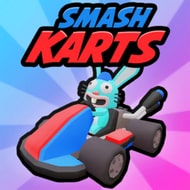
 You round a corner in Neon City with a homing rocket locked onto the kart ahead of you, and just as you’re about to fire, a mine someone dropped behind the nearest barrier catches your back wheel and sends you spinning face-first into a wall. That’s a normal ten seconds in Smash Karts — the lead never belongs to anyone for long, and the arena punishes as happily as it rewards.
| Genre | Arcade kart battler |
| Platform-style | Browser multiplayer arena racer |
| Core Mechanic | Drive, grab weapon pickups, and eliminate opposing karts across timed arena matches |
A standard match runs a few tight minutes, just long enough for the arena to feel small by the halfway mark. Item boxes start respawning around the map, and the objective is simple even when the execution isn’t: rack up eliminations before the clock runs out. New drivers spend their first few matches learning the sightlines on whichever map they land in, since a kart parked around a blind corner with a rocket ready is the single most common way a run ends early.
What separates Smash Karts from a straight race is nobody’s actually trying to finish a lap. Positioning matters more than raw speed, and drivers who treat every match like a shootout on wheels tend to outlast everyone else on the grid.
Item boxes are scattered across every arena, and cracking one open is a small gamble, running from straightforward to genuinely dangerous:
Landing a rocket on a driver mid-turn who can’t juke out of the way is one of the more satisfying feelings the game offers — though the flip side is just as real, since a single well-placed nuke can undo minutes of careful positioning in an instant, which is exactly the kind of moment players still argue about after a match.
Standard battles run as an all-against-all scramble where every kart is a target, but Smash Karts branches past that. Capture the Flag turns the same weapons into an escort mission, since grabbing the flag slows your kart and locks you out of new pickups until you score or lose it. King of the Hill flips the priority — a single crown appears on the map, and whoever holds it earns points every second they keep it from everyone chasing them. Team Deathmatch and Tag round things out for a coordinated fight or a straightforward chase with weapons involved.
Arena choice changes the rhythm of a match. Neon City is tight and vertical, full of corners that reward whoever knows the layout, while Space Station introduces environmental hazards that punish drivers still thinking purely about combat. A foggy Graveyard map plays slower and favors ambush tactics over open shootouts. Smash Karts keeps expanding this map pool, and knowing which arena you’ve loaded into before the countdown ends is often the difference between a strong opening and getting cornered early.
Leveling up through matches pays out coins, hats, wheels, and character tokens, and those tokens feed into a prize machine that hands out new characters at varying rarity tiers. None of it changes how a kart handles — it’s cosmetic — but drivers chasing one specific hat or character combination often keep queueing up for the collection alone.
Beyond the standard all-against-all battles, Smash Karts includes Capture the Flag, King of the Hill, Team Deathmatch, and Tag, each reusing the same weapon pool for a new objective.
Playing matches earns coins, hats, wheels, and character tokens through leveling up, and those tokens feed a prize machine that awards characters and cosmetics at different rarity levels, unrelated to gameplay strength.
The nuke and the lobgrenuke both clear a wide radius and punish anyone who doesn’t put distance between themselves and the blast, far more dangerous in a crowded arena than a single well-aimed rocket.
Smash Karts keeps its formula simple on paper — drive, grab a weapon, survive the Space Station or whatever arena loads next — but it’s the constant threat of a mine or rocket from off-screen that keeps every match from feeling settled.
(0 votes, average: 0.00 out of 5, rated) (0 votes, average: 0.00 out of 5, rated) 
 (1 votes, average: 5.00 out of 5, rated) (0 votes, average: 0.00 out of 5, rated)
  (1 votes, average: 5.00 out of 5, rated)
  (1 votes, average: 5.00 out of 5, rated)
  (1 votes, average: 3.00 out of 5, rated)
 There are no reviews yet. Be the first one to write one.