ADVERTISEMENT
 (1 votes, average: 5.00 out of 5)
 Loading...
Fullscreen
ADVERTISEMENT


 (1 votes, average: 5.00 out of 5)Loading...
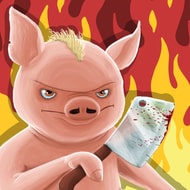
Iron Snout looks like a throwaway flash game about a pig punching wolves, but it plays like a reaction-speed gauntlet that gets faster every few seconds. There’s no health bar cushioning your mistakes — one wolf you don’t see coming from behind, and the run is over.
You control a pig standing in an open clearing, and wolves rush in from both sides in waves that never fully stop. There’s no story setup, no tutorial beyond a few control hints — Iron Snout drops you straight into combat and trusts you to figure out timing through failure.
Wolves come in a handful of distinct types. Regular wolves go down in one or two hits. Armored wolves need a kick to knock their helmet off before a punch actually connects. Wolves carrying weapons — axes, hammers, even the occasional stick of dynamite — will throw them at you, and catching and returning that weapon is often more effective than trying to close distance and fight bare-handed.
The pace ramps up gradually, then all at once. Early waves give you breathing room between wolves; a few minutes in, you’re fielding attacks from three directions while a weapon is mid-air and another wolf is already winding up a swing.
The mechanic that defines Iron Snout for most regular players isn’t the punching, it’s the catch-and-throw system. Any weapon a wolf throws at you can be caught with correctly timed contact and immediately flung back, usually dropping whoever it hits in a single move regardless of armor.
Timing the catch is unforgiving. Swing too early and the weapon sails past you; too late and it connects as a hit instead of a catch. Players who lean into this mechanic tend to survive noticeably longer runs than players who ignore thrown weapons and just keep punching, because a returned axe clears threats that would otherwise take several direct hits.
Reflex-focused players gravitate toward catch-heavy playstyles almost immediately, while newer players often keep trying to out-punch the wave instead, which works fine early but collapses once armored wolves and thrown weapons start overlapping.
Each wolf telegraphs its attack with a short wind-up animation, and learning to read that wind-up rather than reacting to the swing itself is what separates a two-minute run from a much longer one. Kicking during the wind-up interrupts most attacks before they land.
Wolves attacking from directly behind are the most common cause of unexpected losses, since the pig’s default facing doesn’t automatically track every side. Players who develop a habit of glancing or pivoting periodically catch these ambush angles before they become a problem, rather than after taking the hit.
By the time a run has gone on long enough for a giant wolf to show up, the standard rules stop applying. This oversized wolf takes multiple hits, doesn’t flinch from a single punch the way regular wolves do, and forces a shift in approach toward sustained combos instead of quick single-hit exchanges.
One thing players consistently bring up about Iron Snout is that the difficulty scaling feels less like a smooth curve and more like a wall — manageable for a stretch, then suddenly overwhelming once enough wolf types are attacking simultaneously. Some players see this as tight, deliberate design; others find it frustrating that there’s no way to slow the pace back down once it escalates.
What happens if you get overwhelmed by three wolves at once with a weapon already in the air? Usually, nothing good — that specific overlap of a mid-air weapon, an armored wolf mid-windup, and a flanking regular wolf is the scenario most players point to as the moment a long run ends. Managing that overlap instead of panicking through it is really the entire skill ceiling of the game.
There’s no scoring system beyond survival time, which some players in the community wish were expanded, while others argue the simplicity is exactly why Iron Snout stayed replayable years after release.
Iron Snout stays fun precisely because it never lets its own difficulty become predictable — that giant wolf showing up mid-run still catches longtime players off guard, and the pig never gets a health bar to hide behind. It’s a short, sharp loop that rewards reading wolves better than it rewards reflexes alone.
There are no reviews yet. Be the first one to write one.