ADVERTISEMENT
 (1 votes, average: 5.00 out of 5)
 Loading...
Fullscreen
ADVERTISEMENT





 (1 votes, average: 5.00 out of 5)Loading...
You’ve painted your legs a dull rust color to match the shipping container behind you, but your torso is still bright white, and a Seeker is walking straight toward your corner of the Osaka map. This is the exact moment Meccha Chameleon is built around: the half-second where a disguise either holds up under a direct look or falls apart because you rushed the shading. There’s no combat to fall back on here, no reflex-based escape. You either read the environment correctly or you get tagged.
| Genre | Party / Hide-and-Seek |
| Player count | 2–10 recommended |
| Core teams | Hiders and Seekers |
| Modes | Normal, Infection |
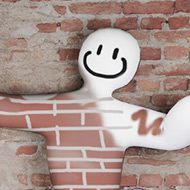
Every round splits the lobby into two roles. Hiders start as plain white figures and get a short window to paint themselves before the hunt begins, using an eyedropper-style tool to sample colors straight from nearby surfaces. Seekers spend that same window doing nothing but wait, which is its own kind of tension if you’re the type who hates being idle. Once the round flips, Seekers patrol the stage with paint guns while Hiders try to stay frozen and convincing.
What separates Meccha Chameleon from a straightforward prop-hunt clone is that Hiders aren’t choosing between a fixed set of disguises. They’re manually recreating whatever’s around them, brush stroke by brush stroke, which means two people hiding behind the same fence post can look completely different depending on how carefully they matched the wood grain.
Competitive players tend to gravitate toward Normal mode, where a knocked-out Hider is simply removed from the round and the Seekers win by clearing the board. Players who enjoy chaos more than precision usually prefer Infection, where every tagged Hider flips to the hunting side, so the pressure escalates round by round instead of resetting.
Beginners almost always make the same mistake early in the game: they pick a hiding spot first and paint second, when it should be the other way around. A convincing color palette in the wrong location still gets you caught, because Seekers aren’t just scanning for color, they’re scanning for silhouettes that don’t belong. By the time you’ve played a dozen rounds on the Osaka map, you start noticing which corners get overused by other Hiders and which ones nobody bothers checking.
Painting is also slower than players expect the first time they try it. A rushed, blotchy attempt at matching a wall’s texture reads as suspicious even from a distance, while a patient two-tone job can survive a Seeker walking directly past it. Streamers who host public lobbies often note that viewers new to Meccha Chameleon burn their entire hiding window fumbling with the brush before they’ve even chosen a pose.
Playground equipment and cluttered indoor rooms tend to reward the most creative Hiders, since a complex, multi-colored surface gives you more to disappear into than a flat wall does.
Beyond color, Meccha Chameleon lets Hiders pick between round, box, and triangle body shapes, along with poses that include a signature wall-cling stance. Clinging to a vertical surface changes your silhouette entirely, and players who understand angles well tend to use it far more effectively than players chasing raw color accuracy alone.
A pose that looks obvious when you’re not under pressure can look completely different once a Seeker’s flashlight-style view sweeps across it. This is where community vocabulary comes in: players talk about “melting” into a wall, meaning a pose and paint combination so convincing that even a close pass doesn’t register anything wrong.
Reverse Chicken Race, a variant mode some players have latched onto, flips the usual pressure by rewarding bold, out-in-the-open positioning instead of tucked-away corners, and it’s become a favorite among players who find pure stealth rounds too slow.
Seekers aren’t just running around clicking on anything suspicious. Weapon choice matters: the basic paint gun is accurate but slow, while the rapid express blaster trades precision for a faster rate of fire, useful once a round shifts into Infection mode and the seeker pool starts growing fast.
Once a Hider is spotted, the actual tag still requires a decent shot, so a Seeker who’s good at spatial reasoning but poor under time pressure can still whiff an obvious catch.
Good Seekers develop habits rather than relying on luck. They check corners methodically, watch for shadows that don’t match the lighting, and listen for the small sound cue that plays when a Hider shifts position at the wrong moment.
It would be dishonest to write about Meccha Chameleon without mentioning the cheating problem players openly discuss on the community boards. Reports of aim-assist style cheats that auto-lock onto Hiders have shown up often enough that some regulars now watch suspicious Seekers mid-match before deciding whether to report or kick them. It’s a real strain on public lobbies, and the developers have pushed anti-cheat updates specifically targeting this behavior.
Alongside that, players occasionally fall through the map or get disconnected from a lobby without explanation, which is a rougher edge for a game built almost entirely around trust between two teams. None of this erases what works, but it’s fair to say Meccha Chameleon still has some stability issues to sort out.
Both work, but they feel different. Private matches with friends tend to produce sillier, more experimental disguises since nobody’s optimizing for a win, while public lobbies get more competitive because strangers are usually there to actually beat the Seekers or clear the board fast.
Match your color to the surface first, then choose a pose like wall-cling that breaks up your silhouette, and avoid popular hiding spots that other Hiders overuse on the same map.
Sometimes it’s genuine skill built from playing enough rounds to know common hiding patterns, but the community has also flagged cheats that auto-target Hiders, which is a known and ongoing problem in public matches.
Meccha Chameleon rewards the kind of patience that most party games don’t bother asking for, and that’s exactly why a round on the Osaka map can still surprise you after dozens of plays. Whether you’re the one melting into a fence post or the Seeker squinting at a shape that doesn’t quite belong, the game keeps coming back to the same simple test: did your disguise actually convince anyone?
 (0 votes, average: 0.00 out of 5, rated) (0 votes, average: 0.00 out of 5, rated)
  (0 votes, average: 0.00 out of 5, rated) (0 votes, average: 0.00 out of 5, rated)
  (1 votes, average: 5.00 out of 5, rated)
  (1 votes, average: 5.00 out of 5, rated)
  (1 votes, average: 3.00 out of 5, rated)
  (0 votes, average: 0.00 out of 5, rated)
  (1 votes, average: 5.00 out of 5, rated)
  (1 votes, average: 5.00 out of 5, rated)
  (1 votes, average: 5.00 out of 5, rated)
  (1 votes, average: 5.00 out of 5, rated)
 There are no reviews yet. Be the first one to write one.